
Degree and career prospects

With a completed Bachelor’s degree in Agricultural Biology, many paths are open to you in a sector that will face growing challenges in the future. As an expert in agricultural production, you will therefore be increasingly in demand. 

But in which areas can you work with a Bachelor’s degree in Agricultural Biology? What exactly can you do with your skills? Or would you perhaps prefer to start a Master’s degree program after all? We present the wealth of opportunities here and give you an outlook on potential jobs, employers, and Master’s degree programs. 
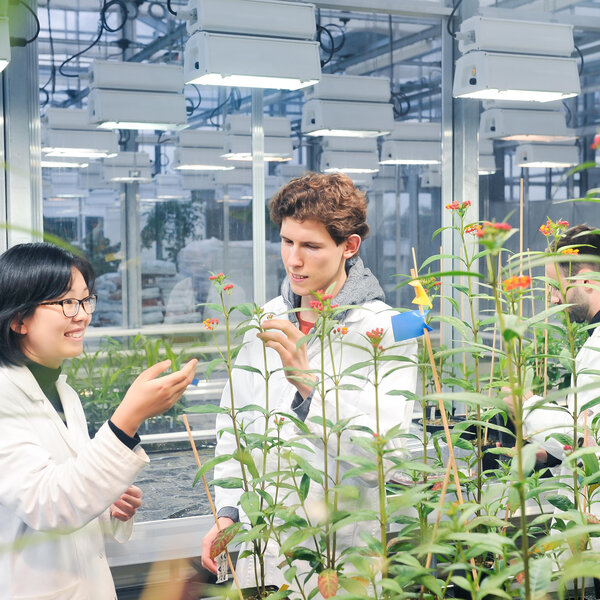
Foto: Drei Personen in weißen Kitteln stehen in einem Gewächshaus und untersuchen Pflanzen mit orangefarbenen Blüten. Im Hintergrund sind technische Geräte und Beleuchtung sichtbar.

Diverse and interesting career possibilities

The topics of nutrition, food production, and the careful use of our resources are increasingly becoming the focus of social awareness. Political efforts are also being made to make agricultural structures fit for the future, to strive for climate neutrality, and to secure the food supply. As you have acquired the ability to understand and assess the growing challenges of different agricultural systems in a global context during your studies, you will be able to develop solutions together in a team.

As an agricultural biologist, you can play a responsible and active role in shaping what these solutions will look like in the future. Whether you want to deal with innovative technologies, you want to work in an advisory capacity or you see yourself in the field of research and development, there are many opportunities open to you. The choice is yours. 

We see you in the following positions and activities, for example:

  • Research and development (e.g., product development)
  • Quality assurance
  • Microbiological and diagnostic procedures and analyses
  • Experts in government authorities and associations
  • Consulting and sales
  • Expert reviewer, typically as a freelancer 

Potential employers include, for example:

  • Chemical and pharmaceutical industry
  • Microbiological and diagnostic laboratories
  • Biotechnology companies
  • University and non-university research institutions
  • Agricultural and food industry
  • Ministries, environmental, and agricultural authorities
  • Feed, animal, and plant breeding companies 

Master’s programs

Do you want to know more?

Then simply continue your studies and acquire additional in-depth knowledge in a Master’s program. Once you have completed your Bachelor’s degree in Agricultural Biology, you can either do a Master’s in the strongly research-oriented Agricultural Biology degree program or choose a degree program with a similar discipline, for example Agricultural Sciences, Biology, or Environmental Sciences.

Depending on your strengths and areas of interest, you decide which subject is right for you following your Bachelor’s degree in Agricultural Biology. With a Master’s degree, you can, for example, aspire to a managerial role in research and development or a business or start a scientific career.