Always in balance: Theory and practice
In order to be successful in your future profession, it is important to be able to apply in practice the knowledge you have learned. Even though universities tend to focus on imparting theoretical knowledge and the latest research results, we do not neglect practical relevance.
Gaining practical experience
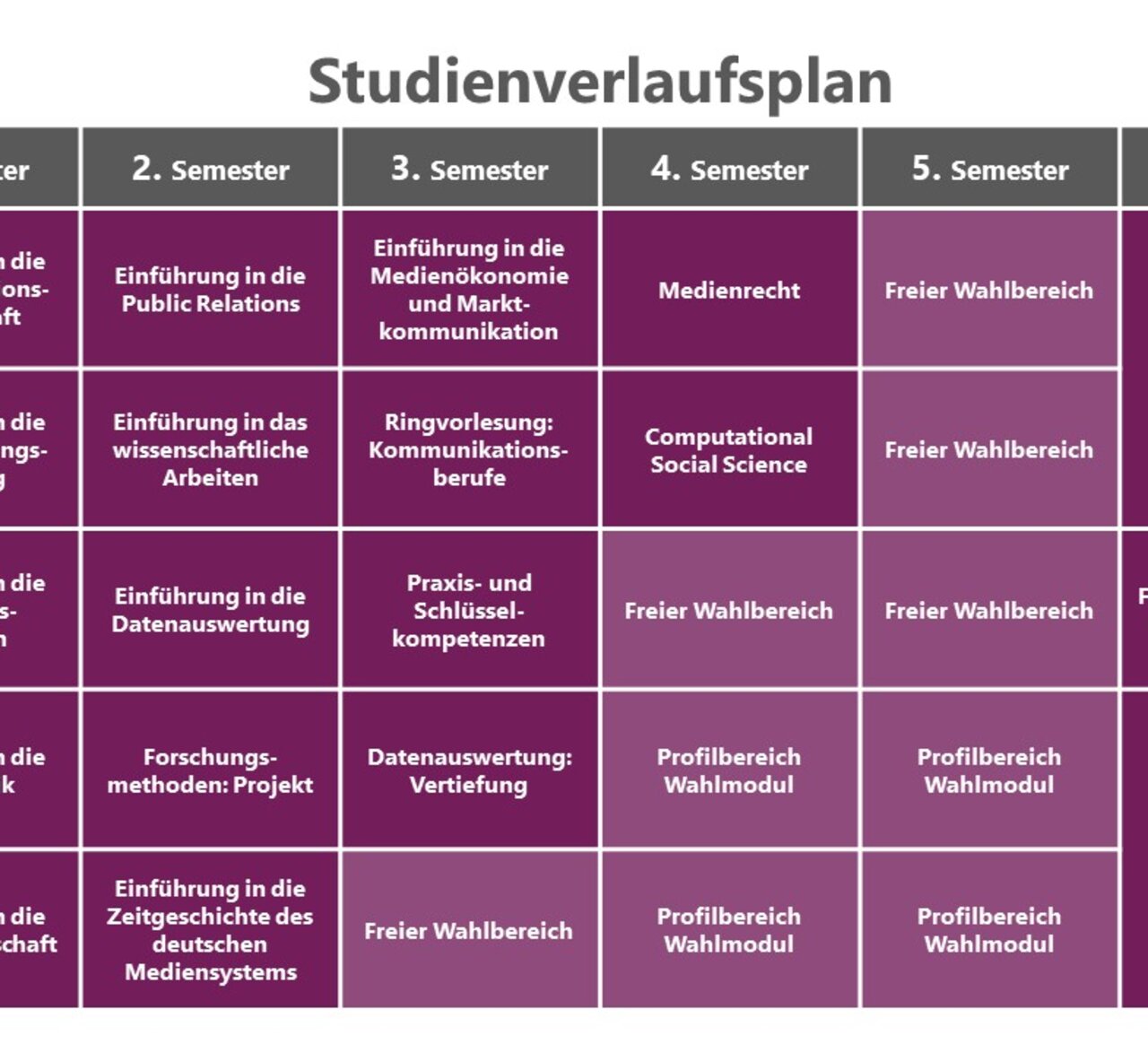
You can gain initial work experience and orientation in the professional world through internships or student jobs during your studies. They offer you the opportunity to gain initial insights into companies and possible professions. A two-month compulsory internship is included in the Communication Science degree program. You also have the opportunity to have a second internship that is counted toward the free elective area or to complete an entire internship semester. Practical elements are also integrated into the courses to prepare you as well as possible for starting your career, and you can apply what you’ve learned directly as you work on projects.
Acquiring new skills
In today’s business world, “soft skills” also play an increasingly important role. These include personal, social, and methodological skills. In addition to specialist knowledge, we therefore attach great importance to professional skills. You can, for example, take continuing education courses on the following topics: Language skills, project management, communication and presentation techniques, IT and media skills, personal development, and techniques for studying and working. This way you can improve these skills during your studies in an easy and cost-effective way. In the practical and key skills module, you can even learn the necessary skills directly during your studies.
F.I.T. further education program
Learning from practice
Learning from practitioners helps you understand how to apply your technical and methodological knowledge. As part of the lecture series on communication professions, practitioners from the business world provide insights into their everyday working lives. At the same time, you can make contacts for future internships.
Learning languages, understanding cultures
It is never as easy to broaden your horizons as during a semester abroad. We therefore recommend that you use this option if you can. You benefit from international experience and cultural exchange and improve your language skills at the same time. These are skills is of great importance in today's world, especially for international companies. With over 80 partner universities in Europe and around the world, you are sure to find one that’s right for you!
Stays abroad
Gaining experience with start-ups
In the "Innovation Greenhouse" everything revolves around sustainable business start-ups: From idea development and evaluation to start-up and subsequent growth of the company, here you will have the opportunity to either work on an exciting start-up, or receive support for your own ideas or start-up company.
Innovation Greenhouse
Researching during your studies
Empirical social research plays an important role in this degree program. From the very beginning, you will collect, analyze, and evaluate data in order to scientifically analyze theories and your own hypotheses. As early as the second semester, you will work in a team to design and carry out your first research project and then present it at the Institute of Communication Studies’ teaching research conference.
Research projects are a wonderful opportunity to apply learned methods and skills in practice, to test your own ideas, and to find solutions to problems. In the university-wide project “Humboldt reloaded,” you can immerse yourself in the world of research during your studies. If you like, you can work on real research projects at an early stage. Experienced scientists will guide you and your team members through the projects, which go far beyond the normal curriculum.
More on student research with Humboldt reloaded